x / therzlt
hello@rzlt.io
x / therzlt
hello@rzlt.io

Iva Dobrosavljevic
Content Writer @ RZLT
AI WEEK Milan 2026: Key Takeaways from Europe's Largest AI Conference
Iva Dobrosavljevic
Content Writer @ RZLT
AI WEEK Milan 2026: Key Takeaways from Europe's Largest AI Conference
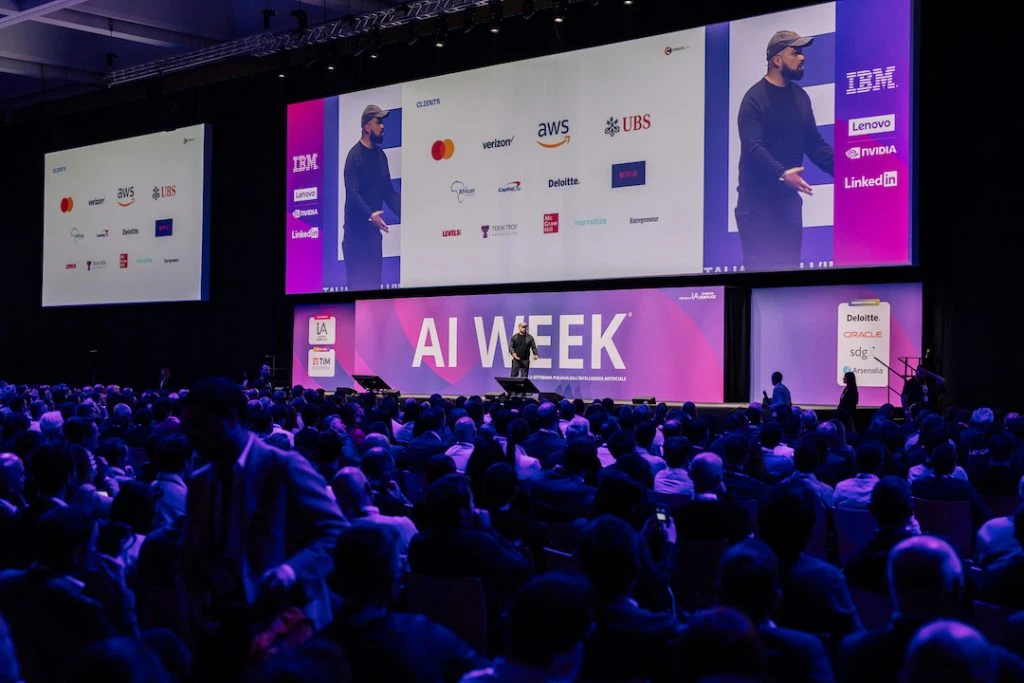
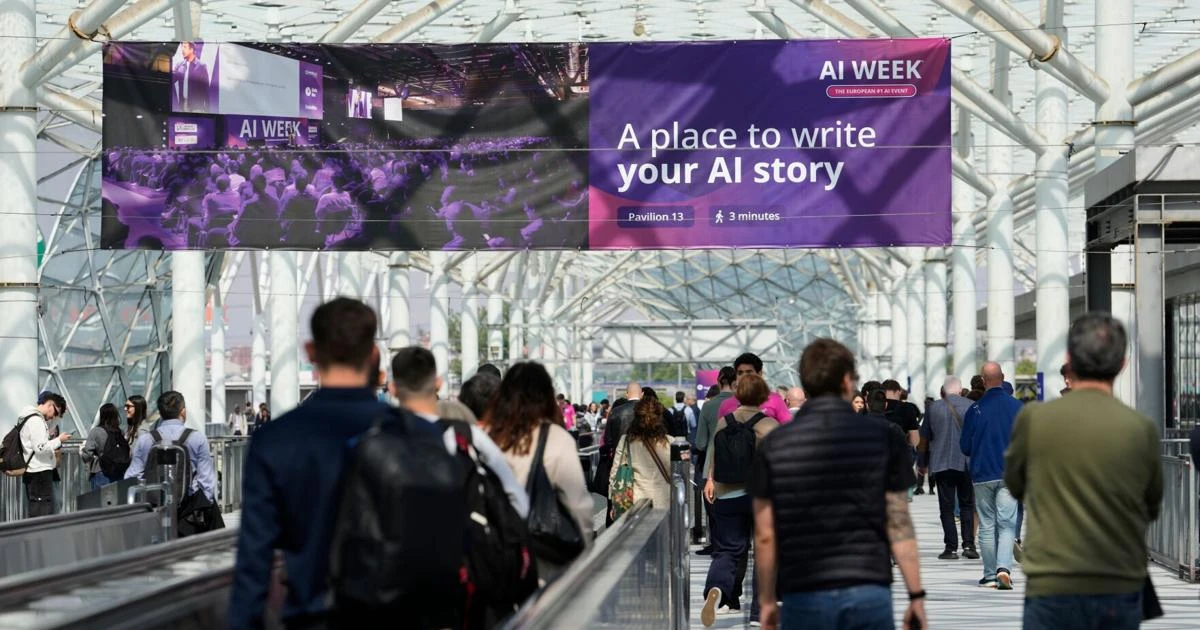
AI WEEK Milan 2026 closed its 7th edition with close to 30,000 attendees, 700 speakers from 78 countries, and 250 exhibitors who sold out floor space before the event opened. RZLT attended as media partners, with Ranko Gajanovic and Josip Vlah on the ground across both days at Fiera Milano Rho. This is what the conference told us about where enterprise AI actually stands.
What AI WEEK Milan 2026 Is
AI WEEK Milan is organized by IA Spiegata Semplice S.r.l., founded by Giacinto Fiore and Pasquale Viscanti. The company grew from an AI-focused podcast into one of Europe's most significant applied AI conferences. The 2026 edition ran May 19 to 20 at Fiera Milano Rho across 17 parallel stages covering enterprise transformation, applied AI marketing, developer tooling, and EU governance.
The year-on-year growth is significant. The 2025 edition drew 17,513 attendees. This year's organizer-reported figure sits at close to 30,000. Speaker count grew 40%, exhibitor count grew 25%, and the number of countries represented tripled.
The Numbers Behind Europe's AI Ambition
The European AI market is projected to grow from €56.7 billion in 2025 to €316.3 billion by 2030, a 457% increase at a CAGR of 33.2%, according to Grand View Research as cited by event organizers. Advertising, marketing and media account for approximately 17.4% of European AI spend, making it the largest commercial vertical by revenue.
The AI Agent Olympics hackathon, run in partnership with lablab.ai from May 13 to 19 online and onsite May 19 to 20, drew 2,381 participants across 734 teams with a $32,000+ prize pool and 270 AI applications submitted. For a side event attached to a conference, those numbers reflect genuine developer interest in applied agentic tooling, not just attendance tourism.
The Dominant Theme: From Chat Interfaces to Agentic Environments
The most important framing at AI WEEK Milan 2026 came from Raffaele Gaito, Italian AI practitioner and founder of IA360, in his Tech Stage session. His argument: 2025 was the year of ChatGPT, Gemini, and Copilot. Traditional chat interfaces where users prompt and receive a response. 2026 marks the arrival of a new category he calls agentic environments: persistent, tool-using AI systems that operate autonomously inside business workflows without requiring human input at every step.
The distinction matters for enterprise buyers. A chat interface is a productivity layer. An agentic environment is an operational redesign. The question shifts from how to give teams better AI tools to how to rebuild processes around AI agents that execute tasks end to end.
Michele Catasta, President and Head of AI at Perplexity, addressed the architectural implications in his session on agentic search systems. Gian Segato, Data Science Manager for Research at Anthropic, focused on evaluation frameworks and safety as agentic systems move from experimental to production. Both sessions pointed in the same direction: the infrastructure layer for agentic AI is being built now.
Enterprise Case Studies Were the Real Agenda
The enterprise track at AI WEEK Milan 2026 was substantive. Engineering's session with Intesa Sanpaolo addressed AI adoption in compliance-sensitive environments, one of the most common blockers for large-scale enterprise deployment. Logotel brought two sessions: one on the Maxi Stage with Italgas covering AI in strategic planning, and one on the Main Stage with INPS covering a citizen-facing community hub built on AI infrastructure. PwC ran three sessions on transformative AI in business processes. Cisco's Gianpaolo Barozzi, VP Global CTO, covered emerging agentic practices across enterprise infrastructure.
The pattern across all of them: these companies are not running pilots. They are in deployment mode, and the problems on the table are operational, not conceptual.
The Speakers Who Set the Frame
The lineup carried genuine weight. Llion Jones, co-author of the 2017 paper "Attention Is All You Need" that introduced the transformer architecture underlying most modern AI systems, appeared as CTO and co-founder of Sakana AI. Karen Hao, author of Empire of AI, winner of the 2025 National Book Critics Circle Award for Nonfiction and named to TIME's 100 AI list, brought a counter-narrative voice to an event otherwise dominated by commercial and enterprise framing.
Lucilla Sioli, Director of the European AI Office, and Maria Cristina Russo, Deputy Director-General for Innovation at the European Commission, gave the event significant governance weight. John Abel, Managing Director EMEA at Google Cloud, and Advait Sarkar, Senior Researcher at Microsoft Research, rounded out a speaker list that covered research, infrastructure, and policy in the same venue.
The EU AI Act: What the 16-Month Window Actually Means
The EU AI Act conversation at AI WEEK Milan 2026 was pragmatic. An EU Omnibus deal has pushed high-risk AI Act obligations from August 2026 to December 2027, giving European enterprises approximately 16 additional months on high-risk compliance. What remains binding on the earlier timeline: transparency obligations, copyright rules, and GPAI model rules.
The extension is real. It is not a pause. Companies treating the 16-month window as a reason to slow down will find themselves compressed at the back end with no room to course correct.
The Italian AI Startup Ecosystem Is Raising Real Capital
The investment activity around AI WEEK Milan 2026 reflects a maturing ecosystem. Verified 2026 funding rounds: Blockbrain at €17.5M Series A for enterprise AI agents, Contents at €5.9M Series B extension for AI workflow orchestration, IdentifAI at €7.2M for AI-generated content detection, and Generative Bionics at €70M for humanoid robotics out of IIT. These are product companies raising growth rounds, not seed-stage experiments.
What AI WEEK Milan 2026 Means for AI-Native Businesses
Agentic AI is operational. The enterprise sessions at AI WEEK Milan 2026 were not pitching the concept. They were reporting deployments, failures, and the next iteration. The workflow redesign question is not upcoming, it is current.
The EU AI Act window is finite. December 2027 is 18 months away. High-risk AI system deployments need compliance infrastructure built before that date, not after it.
The European AI market is scaling faster than most non-European observers are tracking. The conference growth from 17,513 to close to 30,000 attendees in one year, the Italian funding rounds, and the presence of the European AI Office at the center of the conversation all point in the same direction.
RZLT attended AI WEEK Milan 2026 because the European AI market is where a significant portion of our clients' growth is being shaped. If you want to understand what that means for your growth strategy, explore how RZLT works with AI-native businesses.
If your business is still treating agentic AI as something to evaluate, the time to move is now. Talk to us.
AI WEEK Milan 2026 closed its 7th edition with close to 30,000 attendees, 700 speakers from 78 countries, and 250 exhibitors who sold out floor space before the event opened. RZLT attended as media partners, with Ranko Gajanovic and Josip Vlah on the ground across both days at Fiera Milano Rho. This is what the conference told us about where enterprise AI actually stands.
What AI WEEK Milan 2026 Is
AI WEEK Milan is organized by IA Spiegata Semplice S.r.l., founded by Giacinto Fiore and Pasquale Viscanti. The company grew from an AI-focused podcast into one of Europe's most significant applied AI conferences. The 2026 edition ran May 19 to 20 at Fiera Milano Rho across 17 parallel stages covering enterprise transformation, applied AI marketing, developer tooling, and EU governance.
The year-on-year growth is significant. The 2025 edition drew 17,513 attendees. This year's organizer-reported figure sits at close to 30,000. Speaker count grew 40%, exhibitor count grew 25%, and the number of countries represented tripled.
The Numbers Behind Europe's AI Ambition
The European AI market is projected to grow from €56.7 billion in 2025 to €316.3 billion by 2030, a 457% increase at a CAGR of 33.2%, according to Grand View Research as cited by event organizers. Advertising, marketing and media account for approximately 17.4% of European AI spend, making it the largest commercial vertical by revenue.
The AI Agent Olympics hackathon, run in partnership with lablab.ai from May 13 to 19 online and onsite May 19 to 20, drew 2,381 participants across 734 teams with a $32,000+ prize pool and 270 AI applications submitted. For a side event attached to a conference, those numbers reflect genuine developer interest in applied agentic tooling, not just attendance tourism.
The Dominant Theme: From Chat Interfaces to Agentic Environments
The most important framing at AI WEEK Milan 2026 came from Raffaele Gaito, Italian AI practitioner and founder of IA360, in his Tech Stage session. His argument: 2025 was the year of ChatGPT, Gemini, and Copilot. Traditional chat interfaces where users prompt and receive a response. 2026 marks the arrival of a new category he calls agentic environments: persistent, tool-using AI systems that operate autonomously inside business workflows without requiring human input at every step.
The distinction matters for enterprise buyers. A chat interface is a productivity layer. An agentic environment is an operational redesign. The question shifts from how to give teams better AI tools to how to rebuild processes around AI agents that execute tasks end to end.
Michele Catasta, President and Head of AI at Perplexity, addressed the architectural implications in his session on agentic search systems. Gian Segato, Data Science Manager for Research at Anthropic, focused on evaluation frameworks and safety as agentic systems move from experimental to production. Both sessions pointed in the same direction: the infrastructure layer for agentic AI is being built now.
Enterprise Case Studies Were the Real Agenda
The enterprise track at AI WEEK Milan 2026 was substantive. Engineering's session with Intesa Sanpaolo addressed AI adoption in compliance-sensitive environments, one of the most common blockers for large-scale enterprise deployment. Logotel brought two sessions: one on the Maxi Stage with Italgas covering AI in strategic planning, and one on the Main Stage with INPS covering a citizen-facing community hub built on AI infrastructure. PwC ran three sessions on transformative AI in business processes. Cisco's Gianpaolo Barozzi, VP Global CTO, covered emerging agentic practices across enterprise infrastructure.
The pattern across all of them: these companies are not running pilots. They are in deployment mode, and the problems on the table are operational, not conceptual.
The Speakers Who Set the Frame
The lineup carried genuine weight. Llion Jones, co-author of the 2017 paper "Attention Is All You Need" that introduced the transformer architecture underlying most modern AI systems, appeared as CTO and co-founder of Sakana AI. Karen Hao, author of Empire of AI, winner of the 2025 National Book Critics Circle Award for Nonfiction and named to TIME's 100 AI list, brought a counter-narrative voice to an event otherwise dominated by commercial and enterprise framing.
Lucilla Sioli, Director of the European AI Office, and Maria Cristina Russo, Deputy Director-General for Innovation at the European Commission, gave the event significant governance weight. John Abel, Managing Director EMEA at Google Cloud, and Advait Sarkar, Senior Researcher at Microsoft Research, rounded out a speaker list that covered research, infrastructure, and policy in the same venue.
The EU AI Act: What the 16-Month Window Actually Means
The EU AI Act conversation at AI WEEK Milan 2026 was pragmatic. An EU Omnibus deal has pushed high-risk AI Act obligations from August 2026 to December 2027, giving European enterprises approximately 16 additional months on high-risk compliance. What remains binding on the earlier timeline: transparency obligations, copyright rules, and GPAI model rules.
The extension is real. It is not a pause. Companies treating the 16-month window as a reason to slow down will find themselves compressed at the back end with no room to course correct.
The Italian AI Startup Ecosystem Is Raising Real Capital
The investment activity around AI WEEK Milan 2026 reflects a maturing ecosystem. Verified 2026 funding rounds: Blockbrain at €17.5M Series A for enterprise AI agents, Contents at €5.9M Series B extension for AI workflow orchestration, IdentifAI at €7.2M for AI-generated content detection, and Generative Bionics at €70M for humanoid robotics out of IIT. These are product companies raising growth rounds, not seed-stage experiments.
What AI WEEK Milan 2026 Means for AI-Native Businesses
Agentic AI is operational. The enterprise sessions at AI WEEK Milan 2026 were not pitching the concept. They were reporting deployments, failures, and the next iteration. The workflow redesign question is not upcoming, it is current.
The EU AI Act window is finite. December 2027 is 18 months away. High-risk AI system deployments need compliance infrastructure built before that date, not after it.
The European AI market is scaling faster than most non-European observers are tracking. The conference growth from 17,513 to close to 30,000 attendees in one year, the Italian funding rounds, and the presence of the European AI Office at the center of the conversation all point in the same direction.
RZLT attended AI WEEK Milan 2026 because the European AI market is where a significant portion of our clients' growth is being shaped. If you want to understand what that means for your growth strategy, explore how RZLT works with AI-native businesses.
If your business is still treating agentic AI as something to evaluate, the time to move is now. Talk to us.
About RZLT
RZLT is an AI-Native Growth Agency working with 100+ leading startups and scaleups, helping them expand, grow, and reach new markets through data-driven growth strategies, community, content & optimization, generating 200M+ impressions and driving 100M and 60M+ in funding.
Stay ahead of the curve.
Follow us on X, LinkedIn, or subscribe to our newsletter for no BS insights into growth, AI, and marketing.
About RZLT
RZLT is an AI-Native Growth Agency working with 100+ leading startups and scaleups, helping them expand, grow, and reach new markets through data-driven growth strategies, community, content & optimization, generating 200M+ impressions and driving 100M and 60M+ in funding.
Stay ahead of the curve.
Follow us on X, LinkedIn, or subscribe to our newsletter for no BS insights into growth, AI, and marketing.
More articles
Explore our full library of insights, stories, and ideas.
More articles
Explore our full library of insights, stories, and ideas.
More articles
Explore our full library of insights, stories, and ideas.
Ready to take things to the next level?
Contact us
Ready to take things to the next level?
Contact us
Let’s rewrite the playbook.
Contact us