Who sees ChatGPT ads, what they cost, the setup traps, and who should spend. Every claim traced to OpenAI's documentation or our own live Ads Manager account.
Josip Vlah
OpenAI Ambassador (Croatia)
ChatGPT Ads: The Definitive Guide for Advertisers
Who sees ChatGPT ads, what they cost, the setup traps, and who should spend. Every claim traced to OpenAI's documentation or our own live Ads Manager account.
ChatGPT ads reach people who do not pay for ChatGPT. As of August 24, that includes users across 31 European markets.
Self-serve Ads Manager covers nine countries, and Europe buys through OpenAI's managed channels until self-serve arrives later this summer. This guide covers the ad unit, targeting, costs, setup traps, and a plain verdict for every advertiser segment. Updated as the rollout continues and as our campaign data matures.
ChatGPT ads reach people who do not pay for ChatGPT. As of August 24, that includes users across 31 European markets.
Self-serve Ads Manager covers nine countries, and Europe buys through OpenAI's managed channels until self-serve arrives later this summer. This guide covers the ad unit, targeting, costs, setup traps, and a plain verdict for every advertiser segment. Updated as the rollout continues and as our campaign data matures.
Who sees ChatGPT ads, and who never will
Ads serve to two plans: Free, and Go, the reduced-price tier OpenAI positions as low-cost access. Plus, Pro, Business, Enterprise, and Edu accounts stay ad-free, and no account identified as belonging to a minor sees an ad. The policy defines the audience: consumers, students, casual users, budget subscribers, and professionals whose employer has not bought them a workspace seat.
It also defines who is invisible. The people most likely to sit on paid plans are exactly the people enterprise B2B marketers want to reach: engineers, analysts, executives, anyone whose company standardized on ChatGPT Business or Enterprise. They are structurally outside this channel, at any budget. The under-18 exclusion closes the youth market too, which matters for gaming, fashion, and education brands.
Keep this section in mind when you reach the verdict table at the end. Most of it follows from this one paragraph in OpenAI’s Help Center. If your buyers live on paid plans, ads cannot reach them, and your ChatGPT presence becomes citation work, a different discipline.
\What does a ChatGPT ad look like?
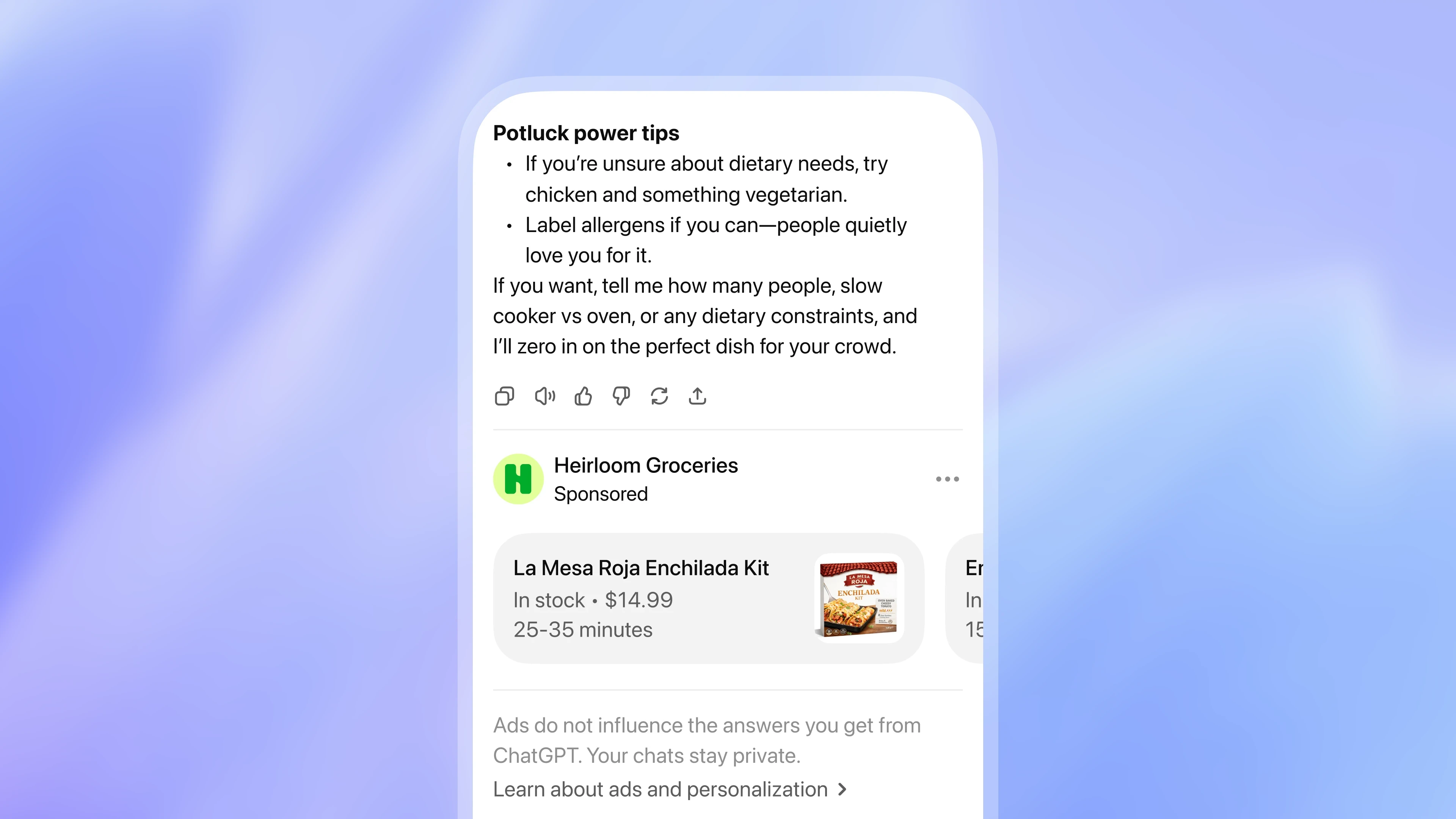
Six components: advertiser name, favicon, title, copy, landing page link, and an image. The unit appears below the response after the answer finishes, with an explicit “Ad” label and a three-dot menu holding user controls. OpenAI’s demo shows a fictional retailer, HarborWest Supply Co., serving an “Easy-install privacy panel” ad under the prompt “I want to build a fence for my backyard.”
The ad sits under a finished answer as a labeled suggestion. It never interrupts the answer itself, and OpenAI selects it on expected relevance to the conversation, so your creative competes with the quality of the answer above it. That is a higher bar than a page of blue links.
Where can you buy ChatGPT ads today?
The user side and the buy side run on different clocks, and today the gap between them is the story.
As of August 24, people across all 31 European markets see ads, per OpenAI’s August 18 expansion announcement, which calls it the company’s largest to date. That takes the user side to 40 markets, six months after the US pilot began on February 9. The buy side looks different: self-serve Ads Manager accounts remain limited to businesses in 9 countries.
Self-serve Ads Manager (9)
Users see ads, self-serve Coming Soon (31)
Australia, Brazil, Canada, Japan, Korea, Mexico, New Zealand, United Kingdom, United States
Every EU member state plus Iceland, Liechtenstein, Norway, and Switzerland: Austria, Belgium, Bulgaria, Croatia, Cyprus, Czech Republic, Denmark, Estonia, Finland, France, Germany, Greece, Hungary, Ireland, Italy, Latvia, Lithuania, Luxembourg, Malta, Netherlands, Poland, Portugal, Romania, Slovakia, Slovenia, Spain, Sweden
European inventory is buyable today, without a local account. OpenAI states that advertisers access the new markets “through the OpenAI Ads Solutions team, agency partners, and technology partners”, with self-serve Ads Manager to follow later this summer. And for self-serve advertisers abroad, the tooling already reaches Europe: OpenAI’s campaign location catalog, a downloadable CSV described in the docs as the list of available targeting locations, contains every EU country as a selectable country-level target. A UK or US account can point campaigns at Germany, France, or Croatia, and as of today there are ads serving there to point at.
One launch condition matters for targeting. OpenAI’s help center states that personalized ads “are not initially available” in the EEA or Switzerland, so European delivery leans on the current conversation and general signals. The context system in the next section is the entire targeting story in Europe at launch.
The window is real and it is short. Until self-serve opens across Europe, the field is advertisers from nine self-serve countries plus whoever routes through OpenAI’s managed channels, and OpenAI puts the total at tens of thousands of marketers across all its markets so far. That is a thin field for 31 new countries, and it thickens the day self-serve arrives. One more signal worth noting: OpenAI’s daily-minimum spend table already lists India, a country absent from the availability page.
There are no keywords, only context hints
Targeting is the biggest conceptual shift in the product, and the fastest way to waste money is to treat it like search. There are no keywords. At the ad-group level you write context hints: short descriptions of the situations, needs, and conversation types where your ad belongs. OpenAI describes them as broad thematic signals, no exact matching and no guaranteed delivery. The system reads the conversation, reads your hints, and decides whether you are relevant. In Europe at launch this is the whole game: with personalization off, the conversation is the targeting.
The fence demo from earlier is the shape of it. The user described a project. No keyword existed to buy, and the ad matched anyway, because “planning a backyard fence installation” is a situation a hint can describe.
OpenAI’s guidance on writing them: describe real user needs in full descriptive phrases, skip standalone terms, cover the several ways customers phrase the same problem, add context the ad title and copy do not carry, and keep every ad group to one product category or intent area. Different audiences get different ad groups. Geography is the one hard control, set at campaign level: countries everywhere in the catalog, plus state, DMA, and ZIP targeting in the United States.
For media buyers, the mental model shift by platform:
Google Ads (Search)
Meta
ChatGPT Ads
What you buy
Queries, via keywords
Audiences, via interest and behavior signals
Situations, via context hints
Match control
Match types and negatives
Detailed targeting, custom and lookalike audiences
Descriptive hints; no exact match, no guaranteed delivery
Where targeting lives
Ad group keywords
Ad set
Ad group context hints
Geographic control
Country down to radius
Country down to radius
Country everywhere; state, DMA, ZIP in the US
Creative logic
Tight message-to-query match
Creative volume feeds the delivery system
Many distinct angles so the system finds relevant conversations
Three settings you can never change
The country or region, the billing currency, and the time zone you pick at account creation are permanent. OpenAI’s setup documentation states they cannot be changed later. The only fix is a new advertiser account, every advertiser account requires a different email address, and an email that has opened one account cannot open another.
The list of one-way doors grew this week. A campaign’s objective is fixed at creation, and converting a campaign-total budget to a daily budget cannot be reversed. Wrong objective or wrong budget type means a new campaign.
We faced the account fork ourselves. Croatia is Coming Soon and RZLT has a London office, so our account runs under the UK entity, in pounds, on UK time, permanently. Every European company enters through the same decision: wait for local availability, or set up under an entity in a live market and accept everything that follows from that choice.
How long does approval actually take?
Identity verification runs through Persona, a third-party provider, during signup. Passing it is necessary and insufficient: OpenAI’s setup FAQ notes that completed verification does not always mean the account is ready to run campaigns. Accounts sit in a rolling review queue, OpenAI states it cannot expedite account or ad reviews, and duplicate applications do not jump the line; they can slow it. Review never fully ends either. Live campaigns can stop mid-flight for account review, business verification, or billing checks, separate from any policy issue.
OpenAI publishes no review timeline. Plan launches around the queue: an account created the week of a product launch will not be serving ads during it.
RZLT handles Ads Manager setup, entity structure, and first campaigns for teams entering the channel. If you want the queue behind you before a launch depends on it, talk to us.
How campaigns are structured in OpenAI Ads Manager
Three levels, and the settings live where you would not expect them:
The campaign level carries more than it did at launch. Platform targeting lets you include iOS app, Android app, and web separately. Campaigns can include or exclude custom audiences, which OpenAI documents in a dedicated setup guide. And there are three ways to build: the guided workflow for individual campaigns, bulk upload from a campaign schema template for scale, and a product feed path that generates feed-based campaigns from an uploaded catalog, aimed squarely at ecommerce.
OpenAI’s structural advice is conventional and correct: one campaign per business goal, region, or product category; several ad groups per campaign to test themes; several ads per ad group to test messaging.
Writing ad creative that actually runs
The creative guidance inverts every habit keyword platforms taught you. OpenAI asks for breadth: a large volume of genuinely different ads gives the system more chances to discover conversations where you are relevant. Each title and description should take a distinct perspective on the product instead of restating one message with new adjectives. Benefit beats clever: state the practical value, who it serves, and when it is useful. Body copy must add information the headline does not already carry.
Landing pages follow the same logic. OpenAI wants product, collection, or content pages and explicitly warns against defaulting to the homepage. UTM parameters can be set per creative, so build the tracking plan into the creative plan.
One gap worth knowing before you write: OpenAI’s public documentation describes what good creative looks like and never states exact character limits or image dimensions. Budget time to fit copy to the fields once you are inside the account.
Suggested drafts come from your metadata, and that is a feature
Ads Manager can pre-populate a new ad for you: image, headline, and description pulled from your website. Everyone will assume this is generative. It is the opposite. OpenAI states plainly: “It doesn’t generate new text or images with AI.” The suggested draft is your own site metadata, reassembled.
Which quietly turns your meta titles and meta descriptions into ad-creative inputs. Pages with lazy, truncated, or duplicate metadata now produce lazy ad drafts, and teams that invested in on-page SEO hygiene start with better creative for free. The drafts are also only as current as your site, so update the source pages before you lean on the feature.
Why are your ads not serving?
Start with the check nobody expects. OpenAI requires that landing pages use valid links and “must not block OpenAI user agents (OAI-AdsBot and OAI-SearchBot)”. Many companies blocked AI crawlers in robots.txt during the 2024 and 2025 training-data standoff. Any of them buying ChatGPT Ads will hit silent disapprovals with no obvious cause. The fix is a five-minute robots.txt review, and the stakes run past advertising: the same crawler access that governs whether ChatGPT cites your site governs whether you can advertise on it.
The rest of the failure modes, all documented by OpenAI:
Failure mode
What OpenAI says
What to do
Account name or logo not set
“Ads will not serve unless this step is complete”
Set both in Settings, Account info, exactly as they should appear in the ad unit
Verified, still nothing
Verification alone does not make an account campaign-ready
Wait out the rolling review queue; reviews cannot be expedited
Ads stopped mid-flight
Delivery can pause for account review, business verification, or billing
Check Ads Manager banners and billing before assuming a policy problem
Status reads Not serving
Hovering the status reveals a reason; most are fixable
Edit the ad and resubmit
Budget or dates
Ads stop at the campaign budget cap and after the end date
Raise the cap or extend the dates
Sources: OpenAI’s account setup guide, quickstart, and FAQ.
What do ChatGPT ads cost?
Three objectives set the pricing model. CPM buys reach, priced per thousand impressions. CPC buys clicks, priced per valid click. oCPC, the newest, still charges per valid click while optimizing delivery toward a tracked conversion event you define. OpenAI recommends opening at a maximum CPC of $3 to $5.
Selection runs through a relevance-weighted second-price auction. You pay just above the next relevant bid rather than your maximum, and relevance shapes who enters the auction at all, so stronger creative lowers your effective cost twice. Ads Manager shows bid-strength guidance while you set bids. Budgets come in two types, campaign-total or daily, with currency-specific daily minimums: $25 in the US, £15 in the UK, and equivalents across the other seven markets. A campaign-total budget caps spend and does nothing to pace it, so money can go fast when your ads match well.
What a click costs in practice, nobody knows. OpenAI’s FAQ states the platform “does not yet have performance benchmarks across advertisers, industries, or campaign types”. Anyone quoting a typical ChatGPT CPC today is guessing.
How do you measure ChatGPT ads?
Ads Manager reports impressions, clicks, spend, CTR, average CPC, average CPM, and conversions, with table and chart views and CSV export. Conversion measurement is configured inside Ads Manager, and oCPC campaigns require a defined conversion event, so set measurement up before you choose that objective. Attribution works the boring, reliable way: static UTM parameters persist through ad clicks and can be set per creative, so your existing analytics stack reads ChatGPT traffic on day one. Measurement is also moving past clicks: alongside the European expansion, OpenAI cites the OpenAI Pixel, a Conversions API, and third-party measurement integrations as the routes for conversion data.
One warning from our own analytics work: audit your bot filtering first. GA4’s default bot exclusion misses several modern AI crawlers, and OAI-SearchBot will now visit every landing page you advertise. We watched unfiltered AI-crawler traffic fake a 3x visitor spike on our own property before we built a proper filter. Clean that up before campaign data starts landing, or your conversion rates will be fiction.
Running ChatGPT Ads at scale
Ads Manager ships with an API, documented at developers.openai.com/ads, with keys exposed in account settings. Bulk upload builds campaigns from a schema template, bulk edit handles changes across many campaigns, and feed-based campaigns give ecommerce catalogs a scaled path. None of this appears in the launch coverage.
For agencies and multi-brand operators, the constraint set is the design problem. One email per advertiser account. Permanent country, currency, and time zone per account. No expedited reviews. Account architecture has to be mapped on paper before anything is created: which entities, which currencies, which markets, which emails. Getting it wrong costs a rebuild under a new email and another trip through the review queue.
Who should spend on ChatGPT Ads today?
Three facts decide this. Ads reach the free tier only. Nine countries can buy. Targeting describes situations rather than queries. From there, the verdicts write themselves, and we will not soften them.
The product is built for you. OpenAI’s demo creative is a home improvement retailer, its only published case study is Newegg, and feed-based campaigns confirm the direction
B2B SaaS selling to SMBs and prosumers
Test now, contained budget
Your buyers plausibly sit on the free tier
B2B SaaS selling to enterprise
Wait
Your buyers are on Business and Enterprise plans and cannot see these ads at any spend level
Local and service businesses
Depends entirely on your market
Viable inside the nine live countries; US advertisers additionally get state, DMA, and ZIP targeting
If you run an EU, EEA, or Swiss business, your verdict above still stands, and as of today there are two routes in. Managed access runs through OpenAI’s Ads Solutions team and its agency and technology partners. Self-serve needs an account in one of the nine Ads Manager countries, which is the path we chose through our UK entity, at least until local self-serve arrives later this summer. The preparation is identical on either route: fix crawler access, build creative volume, and have campaigns drafted before the field thickens.
The enterprise verdict deserves one more sentence, because it is the one people will argue with. The wait is structural: it ends only if OpenAI changes what paid tiers see, and nothing in the current documentation suggests that is planned. For ecommerce and consumer brands, the opposite holds. The entire platform design points at you.
And if you sell in one of the nine self-serve markets, the only thing between you and spend is the review queue. Talk to RZLT and start with the account structured right.
What we are testing, and what we will update
Our position, stated plainly. RZLT runs a live Ads Manager account under our UK entity. Setup is complete, campaigns are entering the queue, and we hold exactly zero performance data. You will find no performance claims anywhere above because none exist yet, from us or from OpenAI. That changes as campaigns run, and this page changes with it.
What lands here next is the material the documentation cannot supply: real review timelines, the exact creative specs from inside the account, and first performance reads once campaigns clear the queue.
Europe’s buy side opened today through managed channels, self-serve lands later this summer, and the setup traps above take longer to clear than most teams expect. If you want the account structured correctly the first time and campaigns live while the field is thin, talk to RZLT.
Who sees ChatGPT ads, and who never will
Ads serve to two plans: Free, and Go, the reduced-price tier OpenAI positions as low-cost access. Plus, Pro, Business, Enterprise, and Edu accounts stay ad-free, and no account identified as belonging to a minor sees an ad. The policy defines the audience: consumers, students, casual users, budget subscribers, and professionals whose employer has not bought them a workspace seat.
It also defines who is invisible. The people most likely to sit on paid plans are exactly the people enterprise B2B marketers want to reach: engineers, analysts, executives, anyone whose company standardized on ChatGPT Business or Enterprise. They are structurally outside this channel, at any budget. The under-18 exclusion closes the youth market too, which matters for gaming, fashion, and education brands.
Keep this section in mind when you reach the verdict table at the end. Most of it follows from this one paragraph in OpenAI’s Help Center. If your buyers live on paid plans, ads cannot reach them, and your ChatGPT presence becomes citation work, a different discipline.
\What does a ChatGPT ad look like?
Six components: advertiser name, favicon, title, copy, landing page link, and an image. The unit appears below the response after the answer finishes, with an explicit “Ad” label and a three-dot menu holding user controls. OpenAI’s demo shows a fictional retailer, HarborWest Supply Co., serving an “Easy-install privacy panel” ad under the prompt “I want to build a fence for my backyard.”
The ad sits under a finished answer as a labeled suggestion. It never interrupts the answer itself, and OpenAI selects it on expected relevance to the conversation, so your creative competes with the quality of the answer above it. That is a higher bar than a page of blue links.
Where can you buy ChatGPT ads today?
The user side and the buy side run on different clocks, and today the gap between them is the story.
As of August 24, people across all 31 European markets see ads, per OpenAI’s August 18 expansion announcement, which calls it the company’s largest to date. That takes the user side to 40 markets, six months after the US pilot began on February 9. The buy side looks different: self-serve Ads Manager accounts remain limited to businesses in 9 countries.
Self-serve Ads Manager (9)
Users see ads, self-serve Coming Soon (31)
Australia, Brazil, Canada, Japan, Korea, Mexico, New Zealand, United Kingdom, United States
Every EU member state plus Iceland, Liechtenstein, Norway, and Switzerland: Austria, Belgium, Bulgaria, Croatia, Cyprus, Czech Republic, Denmark, Estonia, Finland, France, Germany, Greece, Hungary, Ireland, Italy, Latvia, Lithuania, Luxembourg, Malta, Netherlands, Poland, Portugal, Romania, Slovakia, Slovenia, Spain, Sweden
European inventory is buyable today, without a local account. OpenAI states that advertisers access the new markets “through the OpenAI Ads Solutions team, agency partners, and technology partners”, with self-serve Ads Manager to follow later this summer. And for self-serve advertisers abroad, the tooling already reaches Europe: OpenAI’s campaign location catalog, a downloadable CSV described in the docs as the list of available targeting locations, contains every EU country as a selectable country-level target. A UK or US account can point campaigns at Germany, France, or Croatia, and as of today there are ads serving there to point at.
One launch condition matters for targeting. OpenAI’s help center states that personalized ads “are not initially available” in the EEA or Switzerland, so European delivery leans on the current conversation and general signals. The context system in the next section is the entire targeting story in Europe at launch.
The window is real and it is short. Until self-serve opens across Europe, the field is advertisers from nine self-serve countries plus whoever routes through OpenAI’s managed channels, and OpenAI puts the total at tens of thousands of marketers across all its markets so far. That is a thin field for 31 new countries, and it thickens the day self-serve arrives. One more signal worth noting: OpenAI’s daily-minimum spend table already lists India, a country absent from the availability page.
There are no keywords, only context hints
Targeting is the biggest conceptual shift in the product, and the fastest way to waste money is to treat it like search. There are no keywords. At the ad-group level you write context hints: short descriptions of the situations, needs, and conversation types where your ad belongs. OpenAI describes them as broad thematic signals, no exact matching and no guaranteed delivery. The system reads the conversation, reads your hints, and decides whether you are relevant. In Europe at launch this is the whole game: with personalization off, the conversation is the targeting.
The fence demo from earlier is the shape of it. The user described a project. No keyword existed to buy, and the ad matched anyway, because “planning a backyard fence installation” is a situation a hint can describe.
OpenAI’s guidance on writing them: describe real user needs in full descriptive phrases, skip standalone terms, cover the several ways customers phrase the same problem, add context the ad title and copy do not carry, and keep every ad group to one product category or intent area. Different audiences get different ad groups. Geography is the one hard control, set at campaign level: countries everywhere in the catalog, plus state, DMA, and ZIP targeting in the United States.
For media buyers, the mental model shift by platform:
Google Ads (Search)
Meta
ChatGPT Ads
What you buy
Queries, via keywords
Audiences, via interest and behavior signals
Situations, via context hints
Match control
Match types and negatives
Detailed targeting, custom and lookalike audiences
Descriptive hints; no exact match, no guaranteed delivery
Where targeting lives
Ad group keywords
Ad set
Ad group context hints
Geographic control
Country down to radius
Country down to radius
Country everywhere; state, DMA, ZIP in the US
Creative logic
Tight message-to-query match
Creative volume feeds the delivery system
Many distinct angles so the system finds relevant conversations
Three settings you can never change
The country or region, the billing currency, and the time zone you pick at account creation are permanent. OpenAI’s setup documentation states they cannot be changed later. The only fix is a new advertiser account, every advertiser account requires a different email address, and an email that has opened one account cannot open another.
The list of one-way doors grew this week. A campaign’s objective is fixed at creation, and converting a campaign-total budget to a daily budget cannot be reversed. Wrong objective or wrong budget type means a new campaign.
We faced the account fork ourselves. Croatia is Coming Soon and RZLT has a London office, so our account runs under the UK entity, in pounds, on UK time, permanently. Every European company enters through the same decision: wait for local availability, or set up under an entity in a live market and accept everything that follows from that choice.
How long does approval actually take?
Identity verification runs through Persona, a third-party provider, during signup. Passing it is necessary and insufficient: OpenAI’s setup FAQ notes that completed verification does not always mean the account is ready to run campaigns. Accounts sit in a rolling review queue, OpenAI states it cannot expedite account or ad reviews, and duplicate applications do not jump the line; they can slow it. Review never fully ends either. Live campaigns can stop mid-flight for account review, business verification, or billing checks, separate from any policy issue.
OpenAI publishes no review timeline. Plan launches around the queue: an account created the week of a product launch will not be serving ads during it.
RZLT handles Ads Manager setup, entity structure, and first campaigns for teams entering the channel. If you want the queue behind you before a launch depends on it, talk to us.
How campaigns are structured in OpenAI Ads Manager
Three levels, and the settings live where you would not expect them:
The campaign level carries more than it did at launch. Platform targeting lets you include iOS app, Android app, and web separately. Campaigns can include or exclude custom audiences, which OpenAI documents in a dedicated setup guide. And there are three ways to build: the guided workflow for individual campaigns, bulk upload from a campaign schema template for scale, and a product feed path that generates feed-based campaigns from an uploaded catalog, aimed squarely at ecommerce.
OpenAI’s structural advice is conventional and correct: one campaign per business goal, region, or product category; several ad groups per campaign to test themes; several ads per ad group to test messaging.
Writing ad creative that actually runs
The creative guidance inverts every habit keyword platforms taught you. OpenAI asks for breadth: a large volume of genuinely different ads gives the system more chances to discover conversations where you are relevant. Each title and description should take a distinct perspective on the product instead of restating one message with new adjectives. Benefit beats clever: state the practical value, who it serves, and when it is useful. Body copy must add information the headline does not already carry.
Landing pages follow the same logic. OpenAI wants product, collection, or content pages and explicitly warns against defaulting to the homepage. UTM parameters can be set per creative, so build the tracking plan into the creative plan.
One gap worth knowing before you write: OpenAI’s public documentation describes what good creative looks like and never states exact character limits or image dimensions. Budget time to fit copy to the fields once you are inside the account.
Suggested drafts come from your metadata, and that is a feature
Ads Manager can pre-populate a new ad for you: image, headline, and description pulled from your website. Everyone will assume this is generative. It is the opposite. OpenAI states plainly: “It doesn’t generate new text or images with AI.” The suggested draft is your own site metadata, reassembled.
Which quietly turns your meta titles and meta descriptions into ad-creative inputs. Pages with lazy, truncated, or duplicate metadata now produce lazy ad drafts, and teams that invested in on-page SEO hygiene start with better creative for free. The drafts are also only as current as your site, so update the source pages before you lean on the feature.
Why are your ads not serving?
Start with the check nobody expects. OpenAI requires that landing pages use valid links and “must not block OpenAI user agents (OAI-AdsBot and OAI-SearchBot)”. Many companies blocked AI crawlers in robots.txt during the 2024 and 2025 training-data standoff. Any of them buying ChatGPT Ads will hit silent disapprovals with no obvious cause. The fix is a five-minute robots.txt review, and the stakes run past advertising: the same crawler access that governs whether ChatGPT cites your site governs whether you can advertise on it.
The rest of the failure modes, all documented by OpenAI:
Failure mode
What OpenAI says
What to do
Account name or logo not set
“Ads will not serve unless this step is complete”
Set both in Settings, Account info, exactly as they should appear in the ad unit
Verified, still nothing
Verification alone does not make an account campaign-ready
Wait out the rolling review queue; reviews cannot be expedited
Ads stopped mid-flight
Delivery can pause for account review, business verification, or billing
Check Ads Manager banners and billing before assuming a policy problem
Status reads Not serving
Hovering the status reveals a reason; most are fixable
Edit the ad and resubmit
Budget or dates
Ads stop at the campaign budget cap and after the end date
Raise the cap or extend the dates
Sources: OpenAI’s account setup guide, quickstart, and FAQ.
What do ChatGPT ads cost?
Three objectives set the pricing model. CPM buys reach, priced per thousand impressions. CPC buys clicks, priced per valid click. oCPC, the newest, still charges per valid click while optimizing delivery toward a tracked conversion event you define. OpenAI recommends opening at a maximum CPC of $3 to $5.
Selection runs through a relevance-weighted second-price auction. You pay just above the next relevant bid rather than your maximum, and relevance shapes who enters the auction at all, so stronger creative lowers your effective cost twice. Ads Manager shows bid-strength guidance while you set bids. Budgets come in two types, campaign-total or daily, with currency-specific daily minimums: $25 in the US, £15 in the UK, and equivalents across the other seven markets. A campaign-total budget caps spend and does nothing to pace it, so money can go fast when your ads match well.
What a click costs in practice, nobody knows. OpenAI’s FAQ states the platform “does not yet have performance benchmarks across advertisers, industries, or campaign types”. Anyone quoting a typical ChatGPT CPC today is guessing.
How do you measure ChatGPT ads?
Ads Manager reports impressions, clicks, spend, CTR, average CPC, average CPM, and conversions, with table and chart views and CSV export. Conversion measurement is configured inside Ads Manager, and oCPC campaigns require a defined conversion event, so set measurement up before you choose that objective. Attribution works the boring, reliable way: static UTM parameters persist through ad clicks and can be set per creative, so your existing analytics stack reads ChatGPT traffic on day one. Measurement is also moving past clicks: alongside the European expansion, OpenAI cites the OpenAI Pixel, a Conversions API, and third-party measurement integrations as the routes for conversion data.
One warning from our own analytics work: audit your bot filtering first. GA4’s default bot exclusion misses several modern AI crawlers, and OAI-SearchBot will now visit every landing page you advertise. We watched unfiltered AI-crawler traffic fake a 3x visitor spike on our own property before we built a proper filter. Clean that up before campaign data starts landing, or your conversion rates will be fiction.
Running ChatGPT Ads at scale
Ads Manager ships with an API, documented at developers.openai.com/ads, with keys exposed in account settings. Bulk upload builds campaigns from a schema template, bulk edit handles changes across many campaigns, and feed-based campaigns give ecommerce catalogs a scaled path. None of this appears in the launch coverage.
For agencies and multi-brand operators, the constraint set is the design problem. One email per advertiser account. Permanent country, currency, and time zone per account. No expedited reviews. Account architecture has to be mapped on paper before anything is created: which entities, which currencies, which markets, which emails. Getting it wrong costs a rebuild under a new email and another trip through the review queue.
Who should spend on ChatGPT Ads today?
Three facts decide this. Ads reach the free tier only. Nine countries can buy. Targeting describes situations rather than queries. From there, the verdicts write themselves, and we will not soften them.
The product is built for you. OpenAI’s demo creative is a home improvement retailer, its only published case study is Newegg, and feed-based campaigns confirm the direction
B2B SaaS selling to SMBs and prosumers
Test now, contained budget
Your buyers plausibly sit on the free tier
B2B SaaS selling to enterprise
Wait
Your buyers are on Business and Enterprise plans and cannot see these ads at any spend level
Local and service businesses
Depends entirely on your market
Viable inside the nine live countries; US advertisers additionally get state, DMA, and ZIP targeting
If you run an EU, EEA, or Swiss business, your verdict above still stands, and as of today there are two routes in. Managed access runs through OpenAI’s Ads Solutions team and its agency and technology partners. Self-serve needs an account in one of the nine Ads Manager countries, which is the path we chose through our UK entity, at least until local self-serve arrives later this summer. The preparation is identical on either route: fix crawler access, build creative volume, and have campaigns drafted before the field thickens.
The enterprise verdict deserves one more sentence, because it is the one people will argue with. The wait is structural: it ends only if OpenAI changes what paid tiers see, and nothing in the current documentation suggests that is planned. For ecommerce and consumer brands, the opposite holds. The entire platform design points at you.
And if you sell in one of the nine self-serve markets, the only thing between you and spend is the review queue. Talk to RZLT and start with the account structured right.
What we are testing, and what we will update
Our position, stated plainly. RZLT runs a live Ads Manager account under our UK entity. Setup is complete, campaigns are entering the queue, and we hold exactly zero performance data. You will find no performance claims anywhere above because none exist yet, from us or from OpenAI. That changes as campaigns run, and this page changes with it.
What lands here next is the material the documentation cannot supply: real review timelines, the exact creative specs from inside the account, and first performance reads once campaigns clear the queue.
Europe’s buy side opened today through managed channels, self-serve lands later this summer, and the setup traps above take longer to clear than most teams expect. If you want the account structured correctly the first time and campaigns live while the field is thin, talk to RZLT.
About RZLT
Josip Vlah is an OpenAI Ambassador (Croatia) and the founder of RZLT, an AI-native growth agency founded in 2018 with 35+ specialists across 10 countries and 100+ startups and scaleups served. He is also an official Lovable Solutions Partner and n8n Ambassador. This guide documents an OpenAI advertising product from inside a live Ads Manager account.
Sources
All product facts in this guide trace to OpenAI's own documentation and interface:
Ads Manager account setup and quickstart guides, OpenAI Help Center
ChatGPT Ads expands across Europe, OpenAI, August 18, 2026: openai.com/index/chatgpt-ads-expands-across-europe
Ads in ChatGPT: help.openai.com/en/articles/20001047
Euronews, ChatGPT to start showing ads across Europe next week: euronews.com/next/2026/08/21/chatgpt-to-start-showing-ads-across-europe-next-week
About RZLT
Josip Vlah is an OpenAI Ambassador (Croatia) and the founder of RZLT, an AI-native growth agency founded in 2018 with 35+ specialists across 10 countries and 100+ startups and scaleups served. He is also an official Lovable Solutions Partner and n8n Ambassador. This guide documents an OpenAI advertising product from inside a live Ads Manager account.
Sources
All product facts in this guide trace to OpenAI's own documentation and interface: