Iva Dobrosavljevic

Content Writer @ RZLT

Sofia's Claude Code Meetup: What Happened When 220 People Showed Up

Apr 1, 2026

We had 120 spots. 230 people registered. Over 100 showed up on a Wednesday night. Sofia's Claude and Code Meetup was a lot of things, but boring was not one of them.

Iva Dobrosavljevic

Content Writer @ RZLT

Sofia's Claude Code Meetup: What Happened When 220 People Showed Up

Apr 1, 2026

We had 120 spots. 230 people registered. Over 100 showed up on a Wednesday night. Sofia's Claude and Code Meetup was a lot of things, but boring was not one of them.

Sofia's Builder Community Just Showed Its Hand

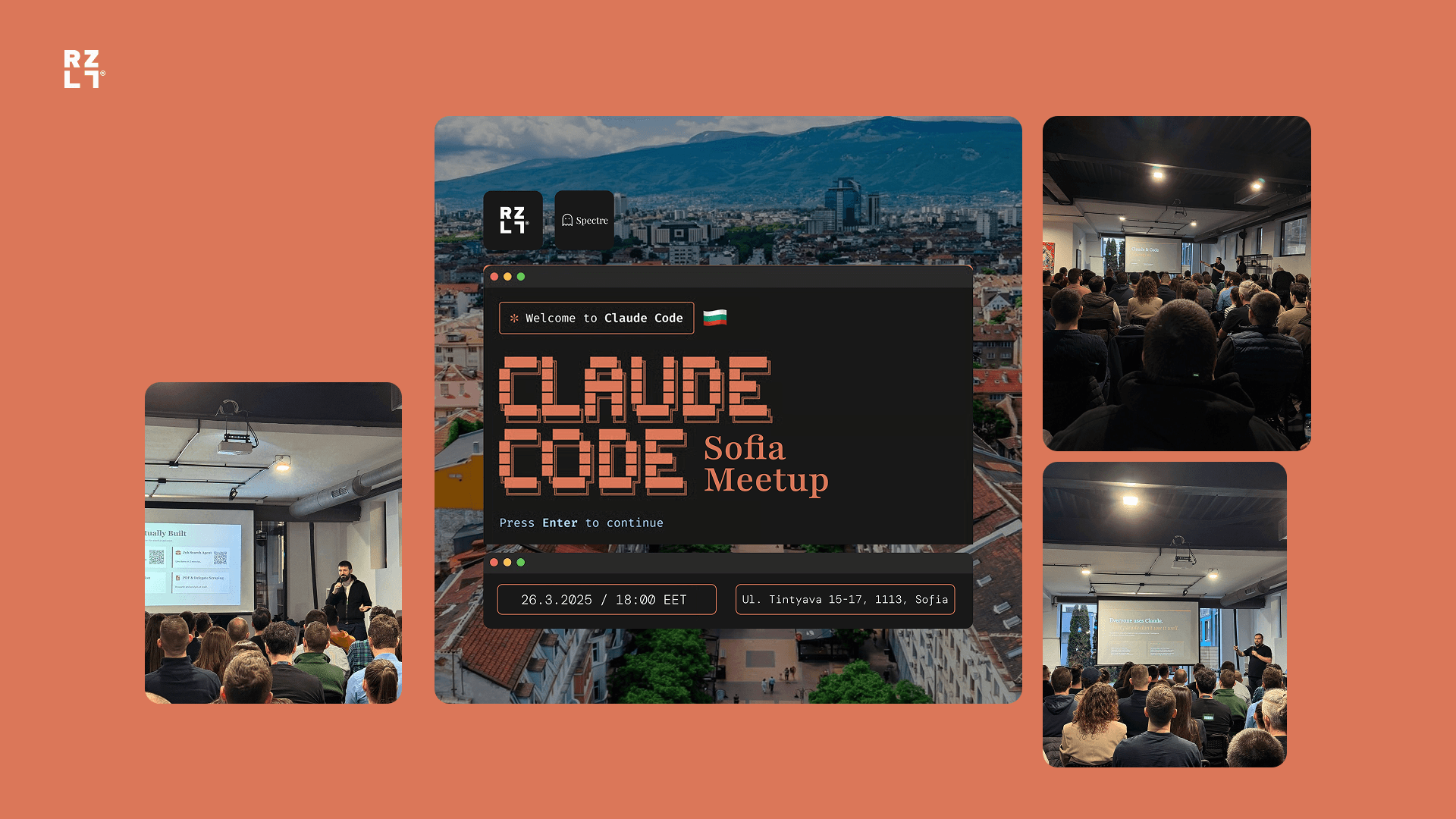
On March 26, 2026, we organized the Claude and Code Meetup in Sofia. We had two talks, one venue, and zero idea the city was this hungry for it. Here is everything that happened and what people actually took home.

We Had 120 Spots. 230 People Signed Up.

We want to be upfront about something. We did not know what to expect walking into Sofia's first Claude and Code Meetup.

120 spots. 230 signups. Over 100 people through the door on a Wednesday evening, which if you have ever tried to get people to show up anywhere on a Wednesday evening, you know is not nothing.

What struck us most was not the number. It was the room. Founders sat next to developers who sat next to marketers who sat next to investors. Everyone was there for the same reason: they wanted to understand what building with AI actually looks like right now, not in theory, not in a LinkedIn post, but in practice.

Sofia has a strong technical community. We knew that going in. But there is a difference between knowing something and seeing a room full of people leaning forward during a talk about context management in Claude Code. That second thing is what we saw.

Two Talks, Both Grounded in Real Usage

The agenda was simple. Luka Ciganek, our CEO, opened with a session on how to use Claude for business and marketing. Branimir Parashkevov, Senior AI Strategist at RZLT, followed with Claude Code. No panels. No fireside chats. Just two people showing work.

Luka: The Gap Is Not Intelligence, It Is Structure

Luka has a way of drawing a line that makes you slightly uncomfortable, because you realize which side of it you are on.

The line he drew in Sofia: most people use Claude. Very few people use it well. And the difference between the two has nothing to do with how smart you are. It is about whether you have built the right structure around it.

He broke this down into what he calls the Professional Stack.

The first layer is Custom Instructions and Style. This is where you define your identity, your rules, your tone. Set it once and every conversation you have with Claude starts from that foundation automatically.

The second layer is Projects. Instead of opening a new chat every time and copy-pasting context into the void, you build persistent project spaces per client or topic. Your files, your instructions, your history all travel with every session.

The third layer is Skills and Connectors. You encode your repeatable processes once. You connect Claude to the tools you actually use, Google Drive, Slack, your CRM. Instead of describing your workflow every time, Claude already knows it.

The fourth layer is Cowork, which is where things get interesting for people who want automation that actually runs. Local file access, sub-agents, scheduled tasks. Luka's framing for this one: it is where automation stops being a demo and starts being infrastructure.

He also showed Claude.ai Projects and Artifacts live in the session. Attendees asked good questions on this part. You could tell people had already been thinking about it and were looking for the piece that clicked it into place.

Branimir: You Do Not Need to Be a Developer

Branimir opened his talk with a statement that clearly landed differently depending on where you were sitting in the room.

"I am not a developer. In the last six months I have shipped production code for enterprise clients."

For the developers in the room: a raised eyebrow, maybe some skepticism. For everyone else: something closer to relief.

Then he spent the rest of the session showing exactly what that looks like in practice.

His background for this talk was real. He has been leading AI adoption across teams of 30+ developers in enterprise environments, not startups, not side projects, but actual production systems with actual stakes. The patterns he shared came from that experience.

The biggest one: when people get poor results from Claude Code, they almost always blame the AI. But the real variable is context. The same question asked with different context gets completely different results. Branimir's advice was to stop trying to perfect your prompts and start thinking about your total context. What files are you including. What architecture decisions have you already documented. What does the model actually need to know to do the job well.

He also talked about the mindset shift that made the biggest difference for the developers he worked with. Stop thinking about Claude Code as a tool. Start thinking about it the way you would think about a new junior team member. Give them context. Structure it clearly. Do not drop them in the deep end and expect magic.

The demos he ran made this concrete. An OSINT agent. A Vue 2 to Vue 3 migration in production that would have taken six months through normal channels and took 40 hours with Claude Code. A job search agent he built live on stage in about two minutes. None of it required knowing the full tech stack in advance.

The line he closed on is the one people kept repeating afterward: the question is not whether you can build it. It is what you should build.

What the Room Was Actually Like

We want to say something about the atmosphere because it was different from a lot of events we have been to.

The conversations after the talks were not the polite, badge-swapping kind. People were asking each other about specific tools, specific workflows, specific problems they were running into. Developers were talking to marketers. Investors were talking to founders about things they had just heard in the talk. It had the energy of a room where people felt like they had learned something they could use the next day.

That is what we were going for. It is not always what you get.

What People Took Away

If we had to pull out the ideas that seemed to stick most, based on the questions during Q&A and the conversations afterward, it would be these.

Using Claude well is a learnable skill and most people have not learned it yet. The Professional Stack Luka laid out is not complicated. It is just not default. Nobody shows it to you. You have to go looking.

Context is the variable almost everyone is ignoring. If your outputs are inconsistent or mediocre, the answer is almost never a better prompt. It is more structured context. Branimir made this point multiple ways and it landed differently for different people in the room, but it landed.

You do not need to be a developer to build things that matter. This was the thing that visibly shifted something for a chunk of the non-technical audience. Branimir did not say it as a motivational line. He showed it with working demos.

Enterprise adoption is hard and the patterns for making it work are specific. Team training sessions often deepen anxiety. One-to-one mentoring with the right framing changes things. That is a learnable playbook.

What Comes Next

Sofia Claude Code Meetup #2 is already in the works. Bigger venue. Same format: real talks, open floor, no filler.

We also have two upcoming events in Zagreb this April. Claude for Work: No-Code Edition on April 9 and Claude Code Meetup Zagreb #2 on April 16. Lisbon is next on the roadmap after that.

If you were in the room in Sofia on March 26, thank you. You made it worth doing.

If you missed it, you know what to do for Meetup #2.

Sofia's Builder Community Just Showed Its Hand

On March 26, 2026, we organized the Claude and Code Meetup in Sofia. We had two talks, one venue, and zero idea the city was this hungry for it. Here is everything that happened and what people actually took home.

We Had 120 Spots. 230 People Signed Up.

We want to be upfront about something. We did not know what to expect walking into Sofia's first Claude and Code Meetup.

120 spots. 230 signups. Over 100 people through the door on a Wednesday evening, which if you have ever tried to get people to show up anywhere on a Wednesday evening, you know is not nothing.

What struck us most was not the number. It was the room. Founders sat next to developers who sat next to marketers who sat next to investors. Everyone was there for the same reason: they wanted to understand what building with AI actually looks like right now, not in theory, not in a LinkedIn post, but in practice.

Sofia has a strong technical community. We knew that going in. But there is a difference between knowing something and seeing a room full of people leaning forward during a talk about context management in Claude Code. That second thing is what we saw.

Two Talks, Both Grounded in Real Usage

The agenda was simple. Luka Ciganek, our CEO, opened with a session on how to use Claude for business and marketing. Branimir Parashkevov, Senior AI Strategist at RZLT, followed with Claude Code. No panels. No fireside chats. Just two people showing work.

Luka: The Gap Is Not Intelligence, It Is Structure

Luka has a way of drawing a line that makes you slightly uncomfortable, because you realize which side of it you are on.

The line he drew in Sofia: most people use Claude. Very few people use it well. And the difference between the two has nothing to do with how smart you are. It is about whether you have built the right structure around it.

He broke this down into what he calls the Professional Stack.

The first layer is Custom Instructions and Style. This is where you define your identity, your rules, your tone. Set it once and every conversation you have with Claude starts from that foundation automatically.

The second layer is Projects. Instead of opening a new chat every time and copy-pasting context into the void, you build persistent project spaces per client or topic. Your files, your instructions, your history all travel with every session.

The third layer is Skills and Connectors. You encode your repeatable processes once. You connect Claude to the tools you actually use, Google Drive, Slack, your CRM. Instead of describing your workflow every time, Claude already knows it.

The fourth layer is Cowork, which is where things get interesting for people who want automation that actually runs. Local file access, sub-agents, scheduled tasks. Luka's framing for this one: it is where automation stops being a demo and starts being infrastructure.

He also showed Claude.ai Projects and Artifacts live in the session. Attendees asked good questions on this part. You could tell people had already been thinking about it and were looking for the piece that clicked it into place.

Branimir: You Do Not Need to Be a Developer

Branimir opened his talk with a statement that clearly landed differently depending on where you were sitting in the room.

"I am not a developer. In the last six months I have shipped production code for enterprise clients."

For the developers in the room: a raised eyebrow, maybe some skepticism. For everyone else: something closer to relief.

Then he spent the rest of the session showing exactly what that looks like in practice.

His background for this talk was real. He has been leading AI adoption across teams of 30+ developers in enterprise environments, not startups, not side projects, but actual production systems with actual stakes. The patterns he shared came from that experience.

The biggest one: when people get poor results from Claude Code, they almost always blame the AI. But the real variable is context. The same question asked with different context gets completely different results. Branimir's advice was to stop trying to perfect your prompts and start thinking about your total context. What files are you including. What architecture decisions have you already documented. What does the model actually need to know to do the job well.

He also talked about the mindset shift that made the biggest difference for the developers he worked with. Stop thinking about Claude Code as a tool. Start thinking about it the way you would think about a new junior team member. Give them context. Structure it clearly. Do not drop them in the deep end and expect magic.

The demos he ran made this concrete. An OSINT agent. A Vue 2 to Vue 3 migration in production that would have taken six months through normal channels and took 40 hours with Claude Code. A job search agent he built live on stage in about two minutes. None of it required knowing the full tech stack in advance.

The line he closed on is the one people kept repeating afterward: the question is not whether you can build it. It is what you should build.

What the Room Was Actually Like

We want to say something about the atmosphere because it was different from a lot of events we have been to.

The conversations after the talks were not the polite, badge-swapping kind. People were asking each other about specific tools, specific workflows, specific problems they were running into. Developers were talking to marketers. Investors were talking to founders about things they had just heard in the talk. It had the energy of a room where people felt like they had learned something they could use the next day.

That is what we were going for. It is not always what you get.

What People Took Away

If we had to pull out the ideas that seemed to stick most, based on the questions during Q&A and the conversations afterward, it would be these.

Using Claude well is a learnable skill and most people have not learned it yet. The Professional Stack Luka laid out is not complicated. It is just not default. Nobody shows it to you. You have to go looking.

Context is the variable almost everyone is ignoring. If your outputs are inconsistent or mediocre, the answer is almost never a better prompt. It is more structured context. Branimir made this point multiple ways and it landed differently for different people in the room, but it landed.

You do not need to be a developer to build things that matter. This was the thing that visibly shifted something for a chunk of the non-technical audience. Branimir did not say it as a motivational line. He showed it with working demos.

Enterprise adoption is hard and the patterns for making it work are specific. Team training sessions often deepen anxiety. One-to-one mentoring with the right framing changes things. That is a learnable playbook.

What Comes Next

Sofia Claude Code Meetup #2 is already in the works. Bigger venue. Same format: real talks, open floor, no filler.

We also have two upcoming events in Zagreb this April. Claude for Work: No-Code Edition on April 9 and Claude Code Meetup Zagreb #2 on April 16. Lisbon is next on the roadmap after that.

If you were in the room in Sofia on March 26, thank you. You made it worth doing.

If you missed it, you know what to do for Meetup #2.
About RZLT

RZLT is an AI-Native Growth Agency working with 100+ leading startups and scaleups, helping them expand, grow, and reach new markets through data-driven growth strategies, community, content & optimization, generating 200M+ impressions and driving 100M and 60M+ in funding.

Stay ahead of the curve.
Follow us on X, LinkedIn, or subscribe to our newsletter for no BS insights into growth, AI, and marketing.

About RZLT

RZLT is an AI-Native Growth Agency working with 100+ leading startups and scaleups, helping them expand, grow, and reach new markets through data-driven growth strategies, community, content & optimization, generating 200M+ impressions and driving 100M and 60M+ in funding.

Stay ahead of the curve.
Follow us on X, LinkedIn, or subscribe to our newsletter for no BS insights into growth, AI, and marketing.

Ready to take things to the next level?

Contact us

Ready to take things to the next level?

Contact us

Let’s rewrite the playbook.

Contact us