x / therzlt
hello@rzlt.io
x / therzlt
hello@rzlt.io

Gavrilo Jejina
Content Writer @RZLT
Learn to Deploy Your Own Production-Ready AI Apps with Emergent
Learn How to Create, Customize, and Launch AI Applications Without Writing a Single Line of Code

Gavrilo Jejina
Content Writer @RZLT
Learn to Deploy Your Own Production-Ready AI Apps with Emergent
Learn How to Create, Customize, and Launch AI Applications Without Writing a Single Line of Code
Emergent is an AI vibe-coding platform for building AI apps in natural language. It turns prompts into full-stack, production-ready web and mobile applications using multi-agent AI. Founded by twin brothers Mukund Jha and Madhav Jha out of Y Combinator's 2024 batch, Emergent raised $100 million in seven months (Series A $23M in September 2025, Series B $70M in January 2026 at a $300 million post-money valuation). The platform reports 5 million users across 190+ countries and $50 million ARR, with a target of $100 million ARR by April 2026.
What Is Emergent
Emergent is an AI-powered no-code development platform where users describe the AI app they want to build in natural language and specialized AI agents handle the design, code generation, testing, and deployment. The platform outputs full-stack, production-ready web and mobile applications.
Emergent sits in the "vibe coding" category. The term entered mainstream usage after Andrej Karpathy posted it on X in February 2025 to describe AI-assisted development where users describe intent conversationally and AI handles implementation. Emergent's competitors in this category include Lovable, Cursor, v0 by Vercel, Bolt.new, and Replit Agent.
Emergent's Growth and Funding in 2026
Emergent's funding trajectory is among the fastest in AI startup history:
Seed round: $7 million from Y Combinator and early angels.
Series A: $23 million in September 2025, led by Lightspeed with participation from Y Combinator, Together, Prosus, and angel investors including Jeff Dean, Balaji Srinivasan, and Devendra Chaplot (Thinking Machines).
Google AI Futures Fund investment: December 2025, per Reuters coverage.
Series B: $70 million in January 2026, jointly led by SoftBank Vision Fund 2 and Khosla Ventures per TechCrunch reporting, at a $300 million post-money valuation. Prosus, Lightspeed, Together, and Y Combinator also participated.
That is $100 million raised within seven months of launch. Per TechCrunch's Series B coverage, Emergent reports 5 million users across 190+ countries and $50 million annual recurring revenue, targeting $100 million ARR by April 2026. Business Insider confirmed the ARR trajectory: from $100,000 to $50 million in seven months.
The founders are San Francisco based, but 70 of Emergent's 75 employees work out of Bengaluru. The Series B marks SoftBank's return to Indian startup investing after a four-year gap.
How Emergent Works
Emergent uses a multi-agent architecture where specialized AI agents handle different parts of app development:
Content agent. Generates copy, text sections, and content structure.
Design agent. Produces layouts, color schemes, and visual elements.
Backend agent. Handles server-side logic, database schema, and API integrations.
Deployment agent. Manages hosting, environment configuration, and production release.
The agents coordinate through Emergent's proprietary foundation models (E1 and E1.1). Users connect existing GitHub repositories to reuse code, upload images for design references, and use full-stack templates for frontend and backend scaffolding.
What You Can Build with Emergent
Emergent's platform outputs cover the main categories of consumer and business software:
Web applications with full backend functionality. SaaS tools, CRMs, e-commerce apps, and admin dashboards.
Cross-platform mobile apps. Built on React Native and Expo.
Landing pages and marketing websites. Production-ready output with hosting handled.
Internal tools. Ops dashboards, client reporting portals, internal AI assistants.
AI agents and coaching apps. Third-party API integrations (OpenAI, Anthropic, and others) with custom knowledge bases.
The iOS app "Emergent AI: Vibe Code Apps," launched in 2026, lets users build directly from iPad or iPhone with real-time preview and cross-device sync between mobile and desktop. Per TechCrunch coverage, the mobile app-building service is seeing strong early adoption.
Emergent vs Other Vibe Coding Platforms
The vibe coding category consolidated around several notable platforms in 2026. Emergent's differentiators against the field:
Full-stack production output. Some platforms (v0, Bolt.new) focus on frontend prototypes. Emergent targets deployable full-stack apps.
Multi-agent architecture. Emergent explicitly separates content, design, backend, and deployment into distinct agents that hand off to each other.
Mobile-first entry point. The iOS app puts building on a phone, not just a laptop.
ARR growth rate. Emergent's growth from $100K to $50M ARR in seven months is the fastest reported trajectory in the category.
How to Get Started with Emergent
Emergent moved out of beta in 2026 and sign-up is straightforward:
1. Create an account. New accounts receive 10 free credits to test the platform. 2. Describe the AI app you want to build. The initial prompt sets the direction. Detailed, specific prompts produce more precise outputs. 3. Configure your app. The platform guides you through content sections, functionality requirements, and design preferences. 4. Preview and iterate. Real-time preview lets you see agents build. Iteration cycles run in seconds. 5. Deploy. Built-in hosting handles production release with zero configuration required.
RZLT Landing Page Built Live in Emergent
Josip Vlah, Partner and Head of Creative at RZLT, demonstrated Emergent by building a landing page for the agency without writing a line of code. His prompt defined content sections, a contact form, and design preferences (bold and creative aesthetic with blue and black accents). The platform generated the full landing page with placeholder data that could be replaced later.
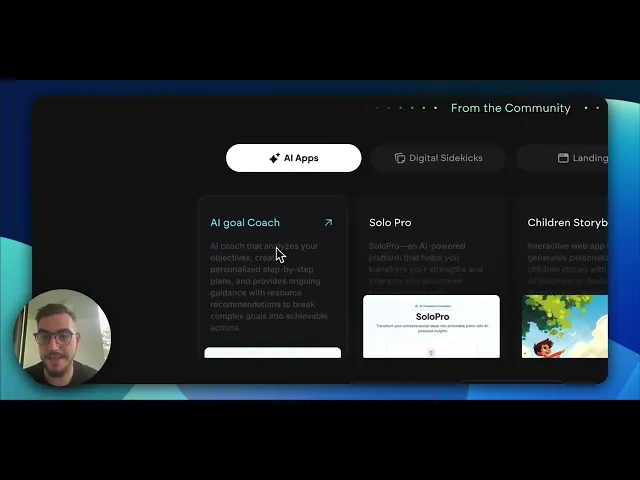
The demo also covered Emergent's broader agent-building capability. Teams can build custom AI agents (a "coaching app" example integrated with OpenAI APIs and a custom knowledge base) that go from prompt to production in a single session. Josip's walkthrough is available on YouTube.
Where Emergent Fits in an AI-Native Marketing Stack
Vibe coding platforms like Emergent fit into AI-native marketing workflows where speed of iteration matters more than infrastructure ownership. For teams building rapid prototypes, internal tools, or client-facing experiences, Emergent slots into four common use cases:
Campaign landing page tests. Ship variants in an hour instead of a week.
Internal ops tools. Client reporting portals, ops dashboards, or team AI assistants without a dev sprint.
Prototype validation. Test product concepts with real interactivity before committing engineering time.
Customer-facing AI agents. Ship agent products that touch APIs and knowledge bases without traditional infrastructure lift.
This fits inside the broader shift RZLT covered in what vibe marketing is and how it works in 2026: humans set taste and strategy, AI handles production and iteration. For how the operating model translates into agency execution, see the RZLT AI growth blueprint on scaling brands with agentic workflows.
RZLT's own production stack ships 60 long-form B2B content pieces per writer per six weeks (5x to 7x manual velocity) through a skill-file architecture on top of Claude and n8n. For the setup guide on running Claude in a similar agentic role, see RZLT's Claude Code walkthrough for long-form content production. Vibe coding platforms extend the same principle from content to product. For the deeper look at the content stack itself, see RZLT's content production stack breakdown.
The Bottom Line
Emergent is the fastest-growing platform in the AI vibe-coding category in 2026. Backed by Y Combinator, SoftBank, Khosla, Google AI Futures, and Lightspeed, it converted $7 million of seed capital into $100 million of funding and $50 million ARR in seven months. For teams building an AI app or a standard web or mobile product in 2026, Emergent offers a natural-language path from concept to production without traditional engineering overhead. For AI-native marketing teams specifically, it slots alongside Claude, n8n, and other agentic tools as a way to compress build cycles from weeks to hours.
Emergent is an AI vibe-coding platform for building AI apps in natural language. It turns prompts into full-stack, production-ready web and mobile applications using multi-agent AI. Founded by twin brothers Mukund Jha and Madhav Jha out of Y Combinator's 2024 batch, Emergent raised $100 million in seven months (Series A $23M in September 2025, Series B $70M in January 2026 at a $300 million post-money valuation). The platform reports 5 million users across 190+ countries and $50 million ARR, with a target of $100 million ARR by April 2026.
What Is Emergent
Emergent is an AI-powered no-code development platform where users describe the AI app they want to build in natural language and specialized AI agents handle the design, code generation, testing, and deployment. The platform outputs full-stack, production-ready web and mobile applications.
Emergent sits in the "vibe coding" category. The term entered mainstream usage after Andrej Karpathy posted it on X in February 2025 to describe AI-assisted development where users describe intent conversationally and AI handles implementation. Emergent's competitors in this category include Lovable, Cursor, v0 by Vercel, Bolt.new, and Replit Agent.
Emergent's Growth and Funding in 2026
Emergent's funding trajectory is among the fastest in AI startup history:
Seed round: $7 million from Y Combinator and early angels.
Series A: $23 million in September 2025, led by Lightspeed with participation from Y Combinator, Together, Prosus, and angel investors including Jeff Dean, Balaji Srinivasan, and Devendra Chaplot (Thinking Machines).
Google AI Futures Fund investment: December 2025, per Reuters coverage.
Series B: $70 million in January 2026, jointly led by SoftBank Vision Fund 2 and Khosla Ventures per TechCrunch reporting, at a $300 million post-money valuation. Prosus, Lightspeed, Together, and Y Combinator also participated.
That is $100 million raised within seven months of launch. Per TechCrunch's Series B coverage, Emergent reports 5 million users across 190+ countries and $50 million annual recurring revenue, targeting $100 million ARR by April 2026. Business Insider confirmed the ARR trajectory: from $100,000 to $50 million in seven months.
The founders are San Francisco based, but 70 of Emergent's 75 employees work out of Bengaluru. The Series B marks SoftBank's return to Indian startup investing after a four-year gap.
How Emergent Works
Emergent uses a multi-agent architecture where specialized AI agents handle different parts of app development:
Content agent. Generates copy, text sections, and content structure.
Design agent. Produces layouts, color schemes, and visual elements.
Backend agent. Handles server-side logic, database schema, and API integrations.
Deployment agent. Manages hosting, environment configuration, and production release.
The agents coordinate through Emergent's proprietary foundation models (E1 and E1.1). Users connect existing GitHub repositories to reuse code, upload images for design references, and use full-stack templates for frontend and backend scaffolding.
What You Can Build with Emergent
Emergent's platform outputs cover the main categories of consumer and business software:
Web applications with full backend functionality. SaaS tools, CRMs, e-commerce apps, and admin dashboards.
Cross-platform mobile apps. Built on React Native and Expo.
Landing pages and marketing websites. Production-ready output with hosting handled.
Internal tools. Ops dashboards, client reporting portals, internal AI assistants.
AI agents and coaching apps. Third-party API integrations (OpenAI, Anthropic, and others) with custom knowledge bases.
The iOS app "Emergent AI: Vibe Code Apps," launched in 2026, lets users build directly from iPad or iPhone with real-time preview and cross-device sync between mobile and desktop. Per TechCrunch coverage, the mobile app-building service is seeing strong early adoption.
Emergent vs Other Vibe Coding Platforms
The vibe coding category consolidated around several notable platforms in 2026. Emergent's differentiators against the field:
Full-stack production output. Some platforms (v0, Bolt.new) focus on frontend prototypes. Emergent targets deployable full-stack apps.
Multi-agent architecture. Emergent explicitly separates content, design, backend, and deployment into distinct agents that hand off to each other.
Mobile-first entry point. The iOS app puts building on a phone, not just a laptop.
ARR growth rate. Emergent's growth from $100K to $50M ARR in seven months is the fastest reported trajectory in the category.
How to Get Started with Emergent
Emergent moved out of beta in 2026 and sign-up is straightforward:
1. Create an account. New accounts receive 10 free credits to test the platform. 2. Describe the AI app you want to build. The initial prompt sets the direction. Detailed, specific prompts produce more precise outputs. 3. Configure your app. The platform guides you through content sections, functionality requirements, and design preferences. 4. Preview and iterate. Real-time preview lets you see agents build. Iteration cycles run in seconds. 5. Deploy. Built-in hosting handles production release with zero configuration required.
RZLT Landing Page Built Live in Emergent
Josip Vlah, Partner and Head of Creative at RZLT, demonstrated Emergent by building a landing page for the agency without writing a line of code. His prompt defined content sections, a contact form, and design preferences (bold and creative aesthetic with blue and black accents). The platform generated the full landing page with placeholder data that could be replaced later.
The demo also covered Emergent's broader agent-building capability. Teams can build custom AI agents (a "coaching app" example integrated with OpenAI APIs and a custom knowledge base) that go from prompt to production in a single session. Josip's walkthrough is available on YouTube.
Where Emergent Fits in an AI-Native Marketing Stack
Vibe coding platforms like Emergent fit into AI-native marketing workflows where speed of iteration matters more than infrastructure ownership. For teams building rapid prototypes, internal tools, or client-facing experiences, Emergent slots into four common use cases:
Campaign landing page tests. Ship variants in an hour instead of a week.
Internal ops tools. Client reporting portals, ops dashboards, or team AI assistants without a dev sprint.
Prototype validation. Test product concepts with real interactivity before committing engineering time.
Customer-facing AI agents. Ship agent products that touch APIs and knowledge bases without traditional infrastructure lift.
This fits inside the broader shift RZLT covered in what vibe marketing is and how it works in 2026: humans set taste and strategy, AI handles production and iteration. For how the operating model translates into agency execution, see the RZLT AI growth blueprint on scaling brands with agentic workflows.
RZLT's own production stack ships 60 long-form B2B content pieces per writer per six weeks (5x to 7x manual velocity) through a skill-file architecture on top of Claude and n8n. For the setup guide on running Claude in a similar agentic role, see RZLT's Claude Code walkthrough for long-form content production. Vibe coding platforms extend the same principle from content to product. For the deeper look at the content stack itself, see RZLT's content production stack breakdown.
The Bottom Line
Emergent is the fastest-growing platform in the AI vibe-coding category in 2026. Backed by Y Combinator, SoftBank, Khosla, Google AI Futures, and Lightspeed, it converted $7 million of seed capital into $100 million of funding and $50 million ARR in seven months. For teams building an AI app or a standard web or mobile product in 2026, Emergent offers a natural-language path from concept to production without traditional engineering overhead. For AI-native marketing teams specifically, it slots alongside Claude, n8n, and other agentic tools as a way to compress build cycles from weeks to hours.
About RZLT
RZLT is an AI-Native Growth Agency working with 100+ leading startups and scaleups, helping them expand, grow, and reach new markets through data-driven growth strategies, community, content & optimization, generating 200M+ impressions and driving 100M and 60M+ in funding.
Stay ahead of the curve.
Follow us on X, LinkedIn, or subscribe to our newsletter for no BS insights into growth, AI, and marketing.
About RZLT
RZLT is an AI-Native Growth Agency working with 100+ leading startups and scaleups, helping them expand, grow, and reach new markets through data-driven growth strategies, community, content & optimization, generating 200M+ impressions and driving 100M and 60M+ in funding.
Stay ahead of the curve.
Follow us on X, LinkedIn, or subscribe to our newsletter for no BS insights into growth, AI, and marketing.
More articles
Explore our full library of insights, stories, and ideas.
More articles
Explore our full library of insights, stories, and ideas.
More articles
Explore our full library of insights, stories, and ideas.
Ready to take things to the next level?
Contact us
Ready to take things to the next level?
Contact us
Let’s rewrite the playbook.
Contact us