x / therzlt
hello@rzlt.io
x / therzlt
hello@rzlt.io

Iva Dobrosavljevic
Content Writer @ RZLT
RZLT and RIT Croatia Host Claude Workshop for Students in Zagreb
Iva Dobrosavljevic
Content Writer @ RZLT
RZLT and RIT Croatia Host Claude Workshop for Students in Zagreb
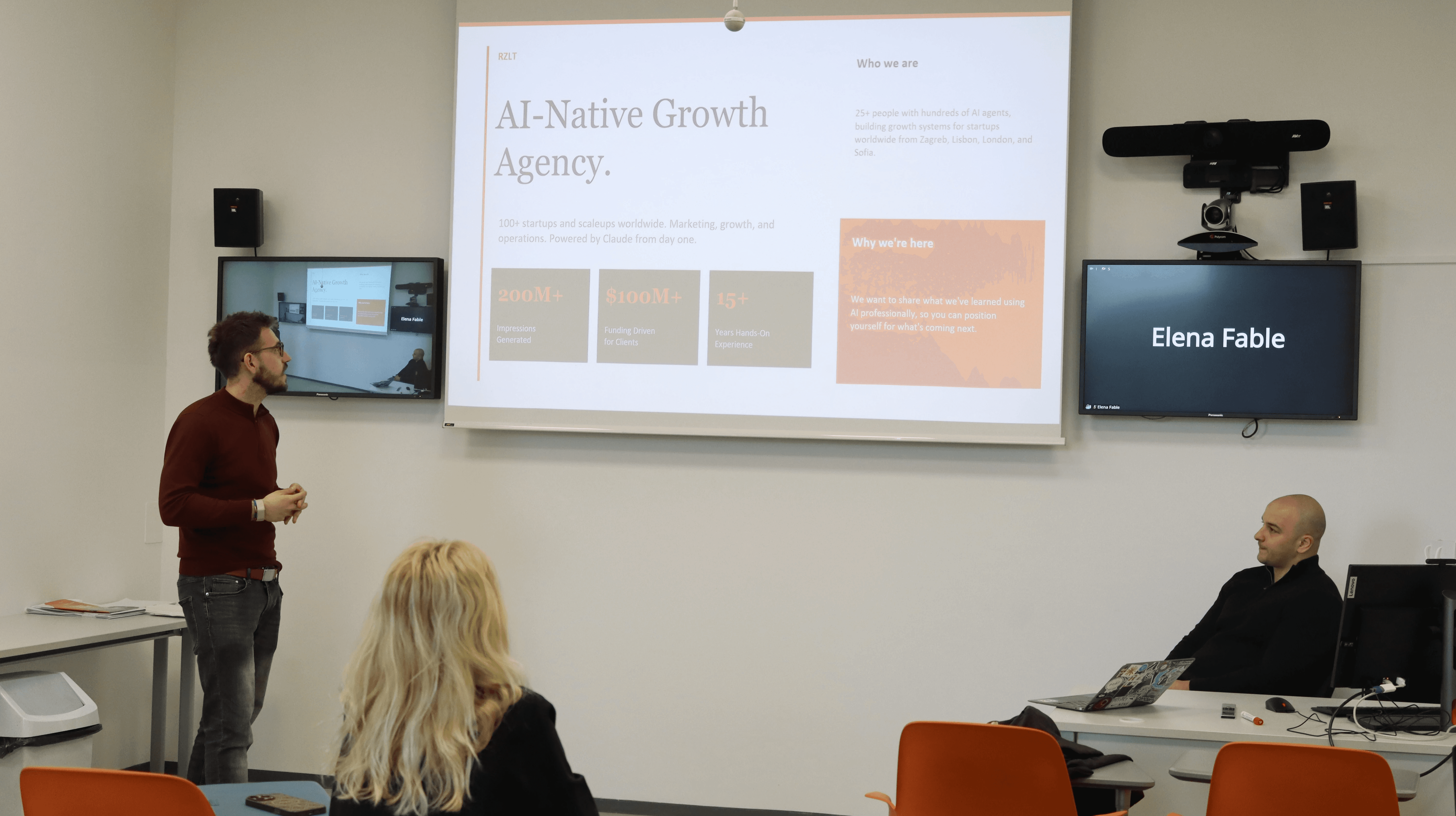
On March 26, RZLT partnered with RIT Croatia to deliver “Claude as Your Thinking Partner,” a hands-on workshop for students at the RIT Zagreb campus covering how to work with AI tools in business, finance, and design. The session was led by Josip Vlah, Partner and Head of Creative at RZLT, and Ranko Gajanovic, Senior Growth Lead at RZLT, and drew students from across RIT Croatia’s programmes at varying levels of AI experience.
The collaboration between RZLT and RIT Croatia reflects a shared view that students benefit more from practitioner-led exposure to AI than from theoretical introductions. RZLT brought its operational frameworks directly into the academic setting, drawing from the agency’s experience running AI-native growth and marketing for 100+ startups worldwide.
Why RZLT and RIT Croatia Partnered on This
RZLT operates across Zagreb, Lisbon, London, and Sofia, running AI-native growth and marketing for 100+ startups worldwide with its full workflow built on Claude. RIT Croatia is one of the global locations of a prominent American university, Rochester Institute of Technology, from Rochester, NY, with campuses in Zagreb and Dubrovnik serving students across business, computing, and design disciplines.
The partnership was built around a gap both organisations recognised. AI workshops for students in Croatia tend to focus on tool familiarity, covering how to use Claude, how to write prompts, and how to speed up assignments. The RIT Croatia and RZLT session was designed around a different question: what does a student need to understand before AI actually makes them better at their work?
“We didn’t come to RIT Croatia to teach students how to prompt. We came to talk about when not to prompt, and why the struggle is the learning. AI technology has to be sequenced, not dumped on students all at once.”
Ranko Gajanovic, Senior Growth Lead, RZLT
What the Workshop Covered
The session opened with a framework RZLT calls AI coexistence, built across seven principles centred on one core idea: you cannot direct, evaluate, or catch errors in Claude's output without first building real skills in the domain you are applying it to.
The progression the framework describes moves through four stages. Working alone first, then using Claude to check your own work, then directing Claude while evaluating its output, then working in genuine partnership with it. Each stage requires demonstrated competence at the previous one, making the model readiness-gated rather than time-gated.
The workshop also covered practical Claude workflows the RZLT team runs for clients in production: a call-to-proposal pipeline using Fireflies and Claude, a full SEO article generation system from keyword research through to CMS publish, an outreach-to-client automation, and a trending topic-to-published-video workflow built across CapCut, OpusClip, and Buffer. Students saw real systems, not demos built for the occasion.
The final section covered business, finance, and design applications specifically, addressing how AI agents integrate into financial workflows, how creative production pipelines are being restructured around AI tools, and where human judgment remains the non-negotiable input regardless of how much of the surrounding process gets automated.
Who Was in the Room
The student audience at RIT Croatia’s Zagreb campus brought a range of experiences that made the session more informative than a uniform group would have. Some students were working through the framework from first principles. Others were already building with AI in production.
Two students presented startups they are actively shipping. One is developing a Bloomberg Terminal-style trading application with a working understanding of AI agents and financial workflow integration. The other is behind Project One, developed out of RIT Croatia. A third student is automating parts of the design process and working in AI-assisted videography and visual content generation.
The Q&A session reflected that range directly. The founders pushed back with technical, specific questions. The rest of the room watched the framework operating in practice, students who built domain expertise first and are now compounding it with AI. The contrast between those two groups made the session’s central argument concrete rather than theoretical.
The Broader Picture for AI Education in Croatia
AI workshops for students in Croatia are becoming more common, but the gap between what universities are formally teaching and what students are building independently continues to grow. Universities across Europe are still working through fundamental questions around ethics, strategy, training, and regulation. The infrastructure conversation is still ongoing. Meanwhile, students at RIT Croatia’s Zagreb campus are already shipping products.
RZLT’s approach is to show up in those spaces rather than wait for formal programmes to catch up. The RIT Croatia collaboration on March 26 is part of an ongoing series of practitioner-led Claude education events the agency runs across Croatia and Bulgaria, including Claude Code meetups in Zagreb and Sofia that have drawn over 140 and 120 attendees, respectively.
The closing point of the workshop was direct. In a few years, AI access will be the baseline across every industry. Domain expertise, critical thinking, and the judgment to know when AI output is wrong are what will separate strong practitioners from average ones, and those things have to be built before the tools arrive.
The "Claude as Your Thinking Partner" session was the first. RZLT is coming back to RIT Croatia with "Intro to Claude Code," this time aimed at IT students and going deeper into what Claude looks like when it has access to an entire codebase.
On March 26, RZLT partnered with RIT Croatia to deliver “Claude as Your Thinking Partner,” a hands-on workshop for students at the RIT Zagreb campus covering how to work with AI tools in business, finance, and design. The session was led by Josip Vlah, Partner and Head of Creative at RZLT, and Ranko Gajanovic, Senior Growth Lead at RZLT, and drew students from across RIT Croatia’s programmes at varying levels of AI experience.
The collaboration between RZLT and RIT Croatia reflects a shared view that students benefit more from practitioner-led exposure to AI than from theoretical introductions. RZLT brought its operational frameworks directly into the academic setting, drawing from the agency’s experience running AI-native growth and marketing for 100+ startups worldwide.
Why RZLT and RIT Croatia Partnered on This
RZLT operates across Zagreb, Lisbon, London, and Sofia, running AI-native growth and marketing for 100+ startups worldwide with its full workflow built on Claude. RIT Croatia is one of the global locations of a prominent American university, Rochester Institute of Technology, from Rochester, NY, with campuses in Zagreb and Dubrovnik serving students across business, computing, and design disciplines.
The partnership was built around a gap both organisations recognised. AI workshops for students in Croatia tend to focus on tool familiarity, covering how to use Claude, how to write prompts, and how to speed up assignments. The RIT Croatia and RZLT session was designed around a different question: what does a student need to understand before AI actually makes them better at their work?
“We didn’t come to RIT Croatia to teach students how to prompt. We came to talk about when not to prompt, and why the struggle is the learning. AI technology has to be sequenced, not dumped on students all at once.”
Ranko Gajanovic, Senior Growth Lead, RZLT
What the Workshop Covered
The session opened with a framework RZLT calls AI coexistence, built across seven principles centred on one core idea: you cannot direct, evaluate, or catch errors in Claude's output without first building real skills in the domain you are applying it to.
The progression the framework describes moves through four stages. Working alone first, then using Claude to check your own work, then directing Claude while evaluating its output, then working in genuine partnership with it. Each stage requires demonstrated competence at the previous one, making the model readiness-gated rather than time-gated.
The workshop also covered practical Claude workflows the RZLT team runs for clients in production: a call-to-proposal pipeline using Fireflies and Claude, a full SEO article generation system from keyword research through to CMS publish, an outreach-to-client automation, and a trending topic-to-published-video workflow built across CapCut, OpusClip, and Buffer. Students saw real systems, not demos built for the occasion.
The final section covered business, finance, and design applications specifically, addressing how AI agents integrate into financial workflows, how creative production pipelines are being restructured around AI tools, and where human judgment remains the non-negotiable input regardless of how much of the surrounding process gets automated.
Who Was in the Room
The student audience at RIT Croatia’s Zagreb campus brought a range of experiences that made the session more informative than a uniform group would have. Some students were working through the framework from first principles. Others were already building with AI in production.
Two students presented startups they are actively shipping. One is developing a Bloomberg Terminal-style trading application with a working understanding of AI agents and financial workflow integration. The other is behind Project One, developed out of RIT Croatia. A third student is automating parts of the design process and working in AI-assisted videography and visual content generation.
The Q&A session reflected that range directly. The founders pushed back with technical, specific questions. The rest of the room watched the framework operating in practice, students who built domain expertise first and are now compounding it with AI. The contrast between those two groups made the session’s central argument concrete rather than theoretical.
The Broader Picture for AI Education in Croatia
AI workshops for students in Croatia are becoming more common, but the gap between what universities are formally teaching and what students are building independently continues to grow. Universities across Europe are still working through fundamental questions around ethics, strategy, training, and regulation. The infrastructure conversation is still ongoing. Meanwhile, students at RIT Croatia’s Zagreb campus are already shipping products.
RZLT’s approach is to show up in those spaces rather than wait for formal programmes to catch up. The RIT Croatia collaboration on March 26 is part of an ongoing series of practitioner-led Claude education events the agency runs across Croatia and Bulgaria, including Claude Code meetups in Zagreb and Sofia that have drawn over 140 and 120 attendees, respectively.
The closing point of the workshop was direct. In a few years, AI access will be the baseline across every industry. Domain expertise, critical thinking, and the judgment to know when AI output is wrong are what will separate strong practitioners from average ones, and those things have to be built before the tools arrive.
The "Claude as Your Thinking Partner" session was the first. RZLT is coming back to RIT Croatia with "Intro to Claude Code," this time aimed at IT students and going deeper into what Claude looks like when it has access to an entire codebase.
About RZLT
RZLT is an AI-Native Growth Agency working with 100+ leading startups and scaleups, helping them expand, grow, and reach new markets through data-driven growth strategies, community, content & optimization, generating 200M+ impressions and driving 100M and 60M+ in funding.
Stay ahead of the curve.
Follow us on X, LinkedIn, or subscribe to our newsletter for no BS insights into growth, AI, and marketing.
About RZLT
RZLT is an AI-Native Growth Agency working with 100+ leading startups and scaleups, helping them expand, grow, and reach new markets through data-driven growth strategies, community, content & optimization, generating 200M+ impressions and driving 100M and 60M+ in funding.
Stay ahead of the curve.
Follow us on X, LinkedIn, or subscribe to our newsletter for no BS insights into growth, AI, and marketing.
More articles
Explore our full library of insights, stories, and ideas.
More articles
Explore our full library of insights, stories, and ideas.
More articles
Explore our full library of insights, stories, and ideas.
Ready to take things to the next level?
Contact us
Ready to take things to the next level?
Contact us
Let’s rewrite the playbook.
Contact us